Product teams rely on behavioral analytics platforms to understand how users actually interact with their digital products, not just what the numbers say.
FullStory is one of the leading tools in this category, used by product managers, UX researchers, engineers, and customer support teams across mid-market and enterprise companies.
In this guide, we’ll break down what FullStory does, its core features, pricing, honest pros and cons, and how it compares to the best alternatives in 2026.
TL;DR:
- FullStory automatically captures every user interaction across web and mobile without manual event tagging, making it one of the most complete behavioral data tools available.
- Pricing scales with session volume and gets expensive fast — real-world contracts range from $10,000 to $200,000+ annually depending on tier and usage.
- FullStory works best for mid-market and enterprise teams in e-commerce, SaaS, and fintech that need session replay and qualitative behavioral insights at scale.
- FullStory is not a standalone analytics platform — most teams run it alongside a separate product analytics tool, which adds to overall cost.
What Is FullStory?
FullStory is a behavioral data and digital experience analytics platform founded in 2014 by former Google engineers, headquartered in Atlanta, Georgia. With a 4.6 rating by Capterra, it serves mid-market and enterprise companies across e-commerce, SaaS, fintech, travel, gaming, and food and beverage sectors.
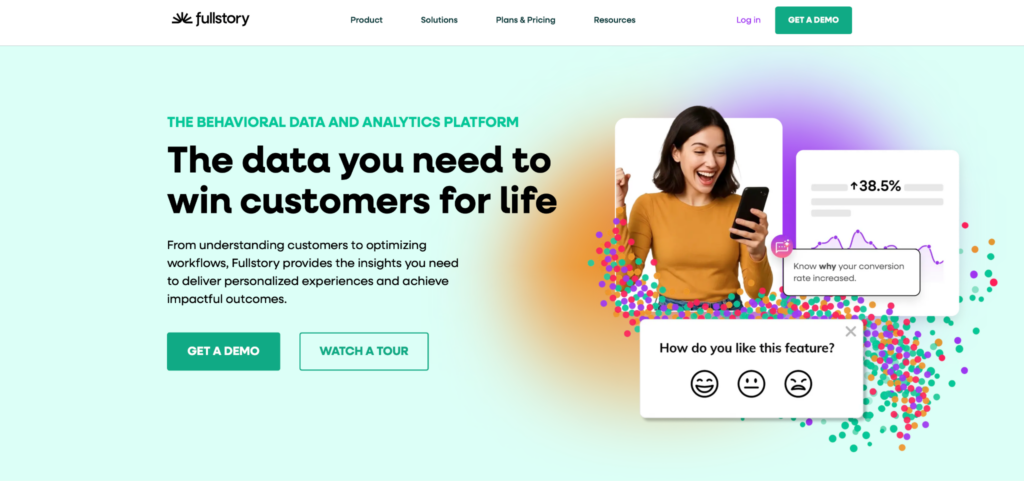
Fullstory automatically captures every user interaction on a website or mobile app, including clicks, scrolls, taps, rage clicks, and form abandonment, without requiring manual event tagging. Product teams, engineers, UX researchers, and customer support teams use it to identify friction points, debug issues, and improve conversion rates. FullStory’s client portfolio includes Chipotle, Pizza Hut, Yankee Candle, and TBC Bank.
Core Features
FullStory’s feature set covers the full range of behavioral analytics, from raw data capture to AI-powered insights. Unlike traditional analytics tools that rely on manual instrumentation,
FullStory automatically collects behavioral data across web and mobile, giving teams a complete picture of the user experience without extra engineering work. Here is what the platform includes:
- Fullcapture — FullStory’s autocapture technology that records every user interaction automatically, no manual event tagging required. Teams get complete behavioral data from day one.
- Session Replay — pixel-perfect recordings of individual user sessions, including clicks, scrolls, taps, and rage clicks. Available for both web and mobile apps.
- Heatmaps — visual maps of where users click, scroll, and move across pages, generated retroactively from captured data.
- Funnels and Conversion Analysis — tracks where users drop off across multi-step flows like checkout or onboarding.
- User Segmentation — filters sessions and data by behavior, device, geography, or custom user attributes.
- Journey Maps — visualizes the paths users take through a product.
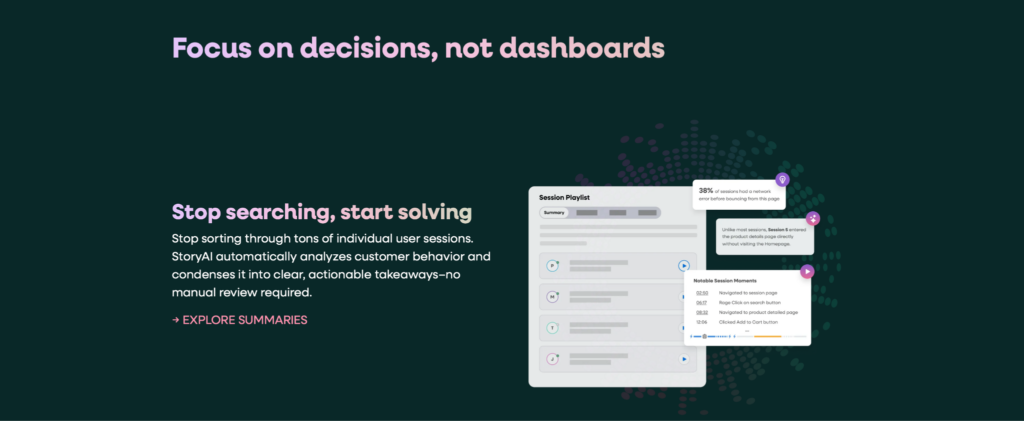
- StoryAI — an AI layer that summarizes sessions, surfaces friction patterns proactively, and answers questions in plain language.
- Guides and Surveys — in-product tours, NPS surveys, and contextual feedback collection, added via the Usetiful acquisition in late 2025.
- Workforce — applies behavioral capture to internal tools, helping IT and operations teams understand how employees use workplace software.
Pricing
FullStory uses a session-based pricing model, meaning costs scale with the number of monthly user sessions your product captures.
All paid plans require contacting sales directly, and your final price depends on session volume, contract length, tier, and any add-ons like mobile analytics.
By default, recording pauses when you hit your session cap, so underestimating your traffic volume can leave you with incomplete data for parts of the month.
- Free — 30,000 sessions per month, 12 months data retention, up to 10 users. Excludes dashboards, mobile analytics, and StoryAI.
- Business — entry-level paid tier covering session replay, heatmaps, core analytics, and segmentation. Real-world contracts typically range from $10,000 to $25,000 annually.
- Advanced — adds premium product analytics, AI-powered session summaries, and deeper integrations. Annual spend commonly falls between $30,000 and $70,000.
- Enterprise — includes mobile app support, advanced security controls, SSO, multi-org management, and dedicated support. Contracts commonly reach $80,000 to $200,000 or more annually.
Note that the pricing is negotiable. If you come to the conversation with a clear budget, annual commitment, and evidence you are evaluating alternatives, you can realistically secure 20 to 35% off the initial quote.
Mobile analytics is also a paid add-on at every tier, which can push mid-tier costs closer to Enterprise levels if your product has a significant mobile user base.
Pros and Cons
FullStory performs well for teams that need deep behavioral visibility, but it comes with trade-offs worth knowing before you commit.
Here is an honest breakdown based on verified user reviews across Capterra, G2, and Gartner Peer Insights:
| Pros ✅ | Cons ❌ |
| – Best-in-class session replay quality – Zero instrumentation setup via autocapture – Frustration signals detected automatically – Cross-team friendly, no technical skills needed – Data available for search within minutes – Strong customer support, responsive account teams – Retroactive analysis without pre-instrumentation | – Expensive at scale, steep renewal increases – Not a standalone analytics platform – Quantitative reporting is limited – Mobile analytics costs extra at every tier – Learning curve for advanced segmentation – Session cap can cause incomplete data – No native A/B testing or feature flags |
The strongest consistent praise centers on session replay fidelity and the zero-setup data capture. Evan W., Principal Digital Product Manager at an enterprise company, rated it 5/5 on G2 in January 2026, writing:
“FullStory offers a best-in-class product that allows me to get a ton of insightful information about my websites, including user metrics, customer journeys, and points of friction.”
While the most common frustration is pricing, particularly sharp cost increases at renewal and the reality that most teams end up running FullStory alongside a separate product analytics tool, which adds to overall spend.
FullStory Alternatives
Although clearly an industry leader, FullStory might not be the right fit for every team, mainly due to pricing and the fact that it lacks native experimentation and error tracking.
There are several alternatives that cover overlapping ground at different price points and with different strengths.
- Hotjar — best for small and mid-size teams that need session replay, heatmaps, and user feedback tools (surveys, polls) in one place. Starts at $39/month, making it far more accessible for early-stage products.
- LogRocket — engineering-first tool that pairs session replay with JavaScript error tracking, network request logging, and console logs. Better suited for teams where session replay is primarily a debugging instrument rather than a UX research tool.
- Microsoft Clarity — completely free, with unlimited session replay, heatmaps, and rage click detection. No product analytics, no AI layer, and no enterprise compliance features, but hard to argue with the price.
- PostHog — open-source platform combining product analytics, session replay, feature flags, and A/B testing. The most generous free tier in the category and EU-hosted cloud for data residency. A strong option for teams that want to consolidate tools.
- Contentsquare — enterprise-grade digital experience platform with zone-based heatmaps and revenue impact analysis. Generally 10 to 20% more expensive than FullStory and similarly focused on large organizations.
If your primary need is quantitative funnel analysis and cohort modeling, dedicated product analytics platforms handle that better than FullStory does on its own.
Final Verdict
FullStory is a strong choice for mid-market and enterprise product teams that need deep behavioral visibility into their digital products. Its session replay quality, zero-instrumentation data capture, and AI-powered insights are genuinely best-in-class, and the platform consistently earns high marks from product managers, UX researchers, and engineering teams alike, reflected in its 4.6/5 rating on Capterra.
That said, it is not the right tool for every team. The session-based pricing model gets expensive fast, particularly as your product traffic grows and mobile analytics costs stack on top. Most teams also find themselves running FullStory alongside a separate product analytics platform for deeper funnel and cohort work, which increases total spend significantly.
FullStory works best if you are at a company with real traffic volume, a dedicated product or UX function, and a clear need to understand the qualitative side of user behavior. If you are pre-Series B, primarily need experimentation capabilities, or are working with a tight analytics budget, one of the alternatives covered above will likely serve you better.
Start with the free tier to validate whether the session replay and behavioral data quality justify the investment before committing to a paid plan.
FAQs
Is FullStory free to use?
FullStory offers a free plan that includes 30,000 sessions per month, 12 months of data retention, and up to 10 users. It excludes dashboards, mobile analytics, and StoryAI. Paid plans require contacting sales for a custom quote.
What is FullStory used for?
FullStory captures every user interaction on a website or mobile app and turns that data into actionable behavioral insights. Product teams use it to identify friction points, debug issues, analyze conversion funnels, and improve the overall user experience without manual event tagging.
How does FullStory compare to Hotjar?
FullStory offers deeper behavioral data capture, more advanced segmentation, and enterprise-grade compliance features. Hotjar is simpler, more affordable, and adds built-in user feedback tools like surveys and polls. Most small and mid-size teams choose Hotjar for the price; larger teams with complex products tend to favor FullStory.
Does FullStory record every user session?
FullStory captures all sessions by default until the monthly session cap is reached, at which point recording pauses automatically. Teams can enable overage blocks of 100,000 additional sessions per billing cycle to avoid gaps in data coverage.
Is FullStory GDPR compliant?
FullStory holds SOC 2 Type II and ISO 27001 certifications and includes privacy controls such as automatic masking of sensitive data, consent-based recording, and user deletion tools. Teams operating under GDPR or CCPA should request explicit written confirmation on data residency and subprocessor details before deployment.
What is StoryAI?
StoryAI is FullStory’s AI layer that automatically summarizes session recordings, surfaces friction patterns across large data sets, and answers behavioral questions in plain language. It is available from the Advanced tier and above, with a Premium version adding proactive opportunity detection called Opportunities and a natural language query tool called Ask StoryAI.
Who is FullStory best suited for?
FullStory targets mid-market and enterprise companies in e-commerce, SaaS, fintech, travel, and gaming that need detailed behavioral analytics at scale. It works best for teams with dedicated product, UX, or analytics functions and sufficient traffic volume to justify the session-based pricing model.